
Meet Us at 140th Canton Fair! Phase 1 Booth:3.1M31 I Phase 2 Booth:10.1 I33-34

×

Guide du retour sur investissement et du coût en kWh des sèche-mains économes en énergie

04 septembre 2026

Réponse rapide 

 Using an energy efficient hand dryer helps reduce washroom power consumption by up to 80% compared to traditional heated units. The Interhasa sèche-mains à grande vitesse deliver fast drying while lowering facility utility expenses.Actual savings depend on rated power, drying time, daily usage, and local electricity rates.

Energy per use (kWh) = Power (W) × Drying Time (seconds) ÷ 3,600,000

Utilisez une formule transparente unique pour chaque sèche-mains

Énergie par utilisation (kWh) = puissance d'entrée nominale (W) × temps de séchage mesuré (s) ÷ 3 600 000. Coût annuel d'électricité = énergie par utilisation × cycles annuels × tarif électrique local. Déclarez séparément l'énergie en veille lorsqu'elle est significative, et utilisez une méthode de test du temps de séchage cohérente entre les modèles comparés.

This guide explains kWh calculations, infrastructure impacts, and ROI metrics for facility managers looking for long-term operational savings. 

How Much Energy Does a Hand Dryer Use?

Hand dryer energy consumption is determined by their wattage rating and drying time. Conventional thermal dryers consume between 1500W and 2300W in 30 seconds, whereas high-speed modern dryers work from 500W to 1000W in just 10 to 12 seconds.

Energy consumption calculations should be done with active power measurement. Shortening drying time significantly reduces total energy consumption per usage.

Hand Dryer Wattage Comparison Table (300W-1800W)

Dryer Model Type Power Rating (Watts) Heating Element Average Dry Time Energy per 100 Uses (kWh)
Ultra-Low Power300WAucun15 seconds0.125 kWh
Compact High-Speed550 WOff / None10 seconds0.153 kWh
Standard High-Speed1000WDual Mode10 seconds0.278 kWh
Traditional Thermal1500WHeated30 seconds1.250 kWh
Heavy-Duty Heated1800WHeated30 seconds1.500 kWh

What is the Energy Impact of No-Heat vs Heated Models? 

A no heat hand dryer or cool air hand dryer takes between 300 to 700 watts and uses up to 65% to 80% less power compared to heated hand dryers. The heated models consume between 1,200 and 1,500 watts of power because the heaters need a lot of energy for evaporation. 

The actual energy savings vary by model and drying time.

Difference in Power Usage

  • Heated hand dryers generally have higher rated power because part of their electrical input is used to operate heating elements. Actual wattage varies considerably by model, so buyers should compare the manufacturer’s rated power and measured energy per drying cycle. 
  • No Heat Machines: Use around 300-700 watts of power. By removing the heating element, no-heat models rely primarily on high-velocity airflow generated by an electric motor to remove water from the hands.

Operational and Costs Impacts

  • Energy Per Use: Energy cost per drying cycle depends on both rated power and drying time. A higher-wattage heated dryer may consume several times more electricity per cycle than a lower-wattage high-speed model. 
  • Electrical Load: Lower-wattage hand dryers generally draw less current, which can simplify electrical planning in some retrofit projects. However, the number of dryers that can share a branch circuit must be determined based on the total calculated load, circuit rating, manufacturer installation instructions, and applicable local electrical codes. 
  • Speed: No heat high-speed machines can remove water in 10 to 12 seconds while the old heated ones take longer time.
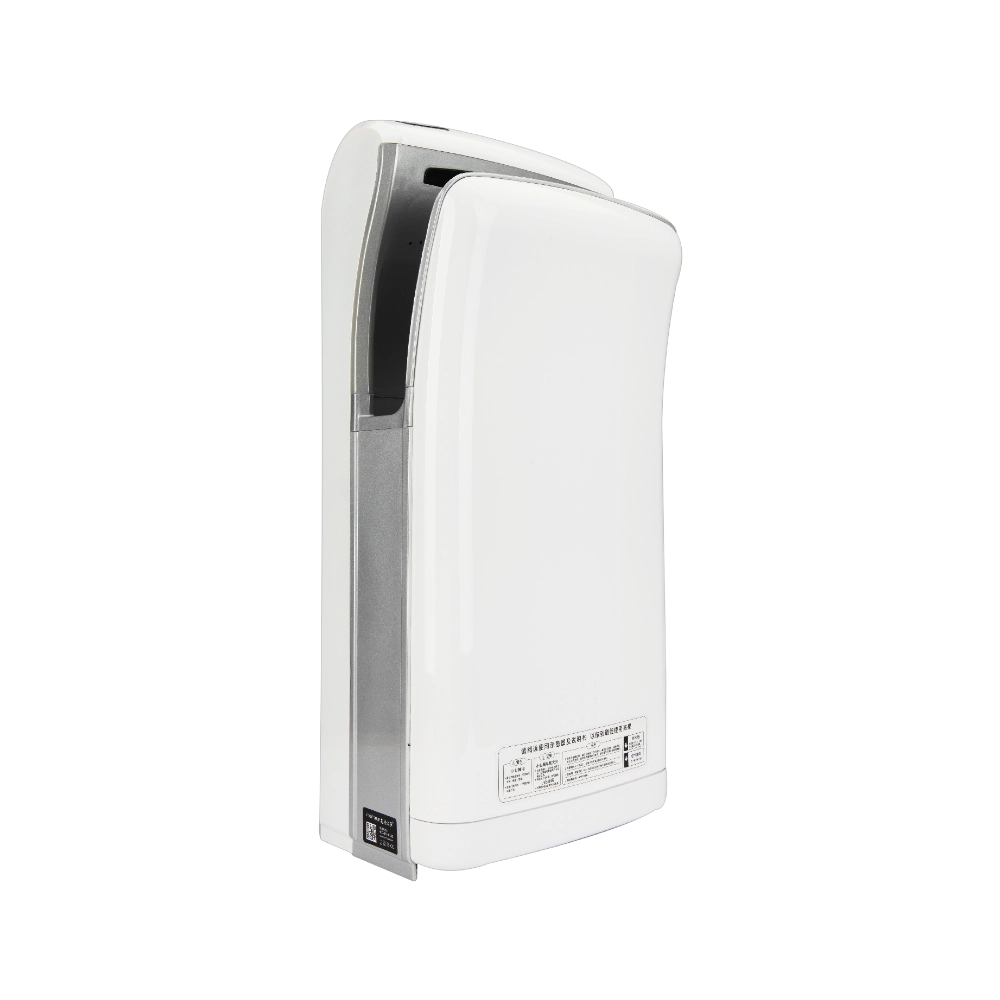
Sèche-mains Interhasa 1688

Interhasa 1688 classic model double side air outlet high speed 1800W hand dryer, with light indicator, 4 infrared sensor, on/off switch, hot/cold switch, multy color available to match your deco design, accept for OEM order or brand distributor.

Explorer le produit
Sèche-mains Interhasa 1688

How To Calculate Estimated Annual Electricity Costs? 

The following equation can be used by facility managers to calculate the annual cost of electricity. Multiply total kW by operating hours, daily user cycles, and your local power rate.

Annual Cost = (Watts ÷ 1000) × (Dry Time in Seconds ÷ 3600) × Daily Uses × 365 × Electricity Rate

Calculation Example

Assume that there is a restroom that uses 200 cycles per day at an electricity cost of $0.15 per kWh.

550W Unheated Unit (10-second dry time):

Annual Cost = (550 ÷ 1000) × (10 ÷ 3600) × 200 × 365 × 0.15

Annual Cost = (0.55) × (0.00278) × 200 × 365 × 0.15

Annual Cost ≈ $16.74

1800W Heated Unit (30-second dry time):

Annual Cost = (1800 ÷ 1000) × (30 ÷ 3600) × 200 × 365 × 0.15

Annual Cost = (1.80) × (0.00833) × 200 × 365 × 0.15

Annual Cost ≈ $164.18

Send your destination voltage, daily traffic estimate, quantity and electricity rate for a model-level operating-cost comparison.

 Comment calculer une période de retour sur investissement défendable pour un sèche-mains

Le retour simple doit utiliser le coût net installé, et non le prix du produit seul. Incluez le sèche-mains, le câblage, les travaux muraux et la mise en service, puis soustrayez tout coût de distributeur évité. Les économies mensuelles doivent inclure les achats de papier, la main-d'œuvre de recharge et la gestion des déchets moins l'électricité, la maintenance et les filtres de remplacement. Publiez chaque hypothèse afin que l'acheteur puisse la remplacer par des données locales.

Entrée ou sortie Symbole Comment l'obtenir Formule ou utilisation Ne pas supposer
Puissance d'entrée nominaleP Page produit officielle du modèle sélectionné, plaque signalétique ou rapport d'essai approuvé Utilisée dans le calcul de l'énergie par utilisation Une puissance moyenne de catégorie
Temps de séchage mesurét Test contrôlé utilisant le modèle approuvé et le critère de mains sèches convenu Utilisée dans le calcul de l'énergie par utilisation Temps marketing d'un autre modèle
Utilisations par jourU Comptage du site, étude de trafic ou estimation conservatrice de l'établissement Utilisations annuelles = U × jours d'exploitation Chaque visiteur utilise le sèche-mains une fois
Tarif électriqueR Facture de l'établissement ou tarif contractuel Appliqué aux kWh annuels Une moyenne nationale lorsque le tarif du site est connu
Coût installé du projetI Unité, fret, droits, installation et travaux électriques requis Investissement initial pour le retour sur investissement Prix du produit seul
Coût des essuie-mains évitéT Factures réelles d'essuie-mains divisées par les séchages réussis Coût annuel des consommables évités Coût par carton sans feuilles/utilisation et gaspillage
Coût de la main-d'œuvre et des déchetsL Temps de recharge, temps de nettoyage, gestion des déchets et registres d'élimination Ajouter uniquement les coûts évitables documentés Toute la main-d'œuvre disparaît après l'installation
Coût de maintenanceM Entretien planifié, filtres, pièces et temps d'arrêt prévu Déduire du bénéfice annuel La maintenance est nulle
Énergie par utilisationE Calculée à partir de P et t vérifiés E (kWh) = P (W) × t (s) ÷ 3 600 000 La puissance nominale seule équivaut au coût par utilisation
Coût annuel d'électricité du sèche-mainsCet Calculé à partir de E, U, jours d'exploitation et R Cet = E × U × jours d'exploitation × R 365 jours d'exploitation pour chaque établissement
Bénéfice net annuelB Calculé à partir des coûts évités et des nouveaux coûts d'exploitation B = T + L – Cet – M Toutes les économies revendiquées sont des économies de trésorerie
Période de retour simpleRetour sur investissement Calculé après approbation des données d'entrée Retour = I ÷ B ; utiliser des unités de temps correspondantes Une affirmation de retour sur investissement sans divulgation des hypothèses

What is the Total Cost Comparison between Hand Dryer and Paper Towels? 

Analyzing hand dryer vs paper towel cost savings highlights massive reduction in ongoing operational expenses. 

Hand dryers reduce the cost of operation in the bathroom to 95%. Although installing them is more expensive than buying paper towels because of the initial capital needed for the purchase and installation, they eliminate ongoing expenses for consumables, storage, restocking labor, and waste disposal.

Estimated Cost Comparison Table

Cost Component Sèche-mains Serviettes en papier
Upfront Cost High ($400 – $2,000 per unit + electrical installation) Low ($30 – $150 per dispenser)
Cost Per Use Negligible ($0.0002 – $0.0018 in electricity) High ($0.01 – $0.03 for 2–3 towels per dry)
Annual Operating Spend Very low ($15 – $100 per year in power) High ($700 – $1,200+ per year for supply)
Hidden Costs Minimal periodic maintenance High labor (restocking, trash, plumbing clogs)
Payback Period 6 to 14 months average ROI Ongoing permanent expense

What are the Key Electrical Infrastructure Considerations?

The installation of the restroom components involves assessing the load of the circuit and distribution of the panel. The heavy load of the power increases the cost of installation in building retrofits.

Circuit Load / Retrofit Costs

An average 1800W dryer consumes 15 Amps at 120V power line. This requires an individual circuit of 20A for each dryer. 

At 550W, the consumption is less than 4.6 Amps at 120V. Three units of 550W can be installed in one 15A circuit branch. This low current draw eliminates panel upgrades, saves copper wiring, and cuts electrical installation costs.

How to Choose a Low-Wattage Model?

To choose low-wattage models, consider the design of the motor, choice of materials used to build the housing, and customizing capabilities by the manufacturer before buying. Personalized B2B negotiations with the manufacturer provide room for customized solutions based on facility voltages.

The factory-direct approach provides for personalized tuning of the motor and better pricing because of volume ordering. Ordering the motors with custom wattage will ensure proper balance between airflow, noise, and power consumption.

Interhasa offers commercial hand dryer models with different power ratings, drying times, materials, and voltage configurations for offices, hospitality, public facilities, and high-traffic commercial environments. Visit our Hand Dryer Catalog ou contact us to request customized low-power solutions and prices.

FJ6/ST Spring-type DIN Rail Terminal Block

Safer Experience: Built-in heating element with multiple protections for long life.
HEPA Filter: High-quality built-in HEPA filter for hygienic, pure air flow.
Adjustable Cold and Hot Wind Mode: Cold and hot air exchange for different seasons.
Durable material: Premium ABS, waterproof, strong, wear-resistant, for various places.
3-Year Warranty: 3-year manufactory limited warranty with free parts and good service.

Explorer le produit
FJ6/ST Spring-type DIN Rail Terminal Block

 Comment les acheteurs devraient vérifier les allégations d'efficacité énergétique

Avant d'accepter une allégation “ jusqu'à 80% ”, demandez la puissance d'entrée testée, le temps de séchage, la puissance en veille, les conditions de test et la base de comparaison. Un modèle à puissance inférieure n'est pas automatiquement plus efficace s'il met beaucoup plus de temps à sécher les mains. Les achats devraient comparer l'énergie par séchage complet et la durée de vie prévue du moteur.

Buyer Checklist 

Energy-Efficient Hand Dryer Buying Checklist

  • Rated power (W)
  • Drying time per cycle
  • Energy consumption per cycle
  • Standby power
  • Voltage and frequency
  • Circuit requirements
  • Motor efficiency
  • Niveau de bruit
  • Filter/maintenance requirements
  • Garantie
  • Expected service life
  • OEM/ODM availability
Carte CTA

Demande de documents électriques

Demandez les documents relatifs à la puissance, au temps de séchage et à l'électricité pour les modèles présélectionnés.

Voir plus →

Principaux points à retenir

  1. Hand dryer energy consumption depends on both power rating and drying time, not wattage alone.
  2. Energy per use can be calculated by multiplying power consumption by operating time and converting the result to kWh.
  3. A 550W hand dryer operating for 10 seconds uses approximately 0.00153 kWh per drying cycle.
  4. Hand dryer ROI depends on equipment cost, installation, electricity, paper towel savings, maintenance, and daily usage.

Retour simple (mois) = Coût net installé ÷ Économies mensuelles sur les coûts d'exploitation. Présentez le coût net installé, l'électricité, le papier, la main-d'œuvre de recharge, la gestion des déchets et la maintenance comme des données d'entrée distinctes afin que les acheteurs puissent remplacer les hypothèses par des devis locaux.

Foire aux questions (FAQ) 

1. What is the most energy-efficient type of dryer?

  • The most energy-efficient dryers are those that employ the heat pump technology, for restroom hand dryers, energy efficiency depends mainly on measured input power, drying time, standby power and the number of cycles.

2. What is an energy-efficient dryer?

  • Energy-efficient dryers consume the lowest amount of electricity as compared to other types, up to 60% less than vented or condenser dryers. They utilize a closed system where the same warm air is cycled and reused.

3. How much electricity does a hand dryer use?

  • Les séchoirs à mains utilisent normalement jusqu'à 500 W à 2000 W d'électricité par session de séchage. L'énergie par cycle doit être calculée par modèle. Par exemple, 550 W × 10 secondes ÷ 3 600 000 = 0,00153 kWh par session de séchage, la consommation d'énergie est négligeable—1 800 W × 30 secondes ÷ 3 600 000 = 0,015 kWh.

BLOGS RÉCENTS
UV Soap Dispensers: Does UV Light Really Kill Germs?

Quick Answer  While does UV kill germs is proven by science, a UV soap dispenser can only act as a primary defense on any liquid soaps and dispensing nozzles, but not as an instant liquid sterilization. For facility managers, choosing a UV-C soap dispenser provides an extra layer of hygiene, provided the device adheres to […]

septembre 30, 2026
Top 10 Soap Dispenser Manufacturers & Wholesale Suppliers in China

Quick Answer  Finding the right soap dispenser manufacturer requires evaluating factory capacity, compliance standards, and order minimums. For businesses seeking a soap dispenser wholesale supplier in China, Interhasa provides automatic and manual commercial soap dispensers with full international certifications.  This guide helps bathroom importers, brand owners, and wholesalers select top Chinese suppliers for global distribution. […]

septembre 30, 2026
CE vs SASO vs GOST : Quelle est la bonne certification d'exportation pour vos accessoires de salle de bain ?

Réponse rapide Choisir la bonne stratégie de certification d'exportation pour les accessoires de salle de bain dépend de votre pays cible ou de vos clients spécifiques. L'Europe exige la conformité CE, l'Arabie saoudite applique les normes SASO, tandis que la Russie adhère aux réglementations GOST. Néanmoins, les accessoires de salle de bain Interhasa sont entièrement conformes aux normes internationales de sécurité et de qualité. Cet article explique les parcours de certification technique pour éviter les douanes […]

septembre 09, 2026
OBTENIR UN CONTACT POUR
ENVOYEZ-NOUS UN MESSAGE
Obtenir un devis
Recherche
COLLABOREZ AVEC LES EXPERTS EN SÈCHE-MAINS.

En tant que fabricant certifié, nous proposons des prix de gros compétitifs et des solutions personnalisées pour votre marque.