
Meet Us at 140th Canton Fair! Phase 1 Booth:3.1M31 I Phase 2 Booth:10.1 I33-34

×

Guia de ROI e Custo em kWh de Secadores de Mãos com Eficiência Energética

4 de setembro de 2026

Resposta rápida 

 Using an energy efficient hand dryer helps reduce washroom power consumption by up to 80% compared to traditional heated units. The Interhasa secadores de mãos de alta velocidade deliver fast drying while lowering facility utility expenses.Actual savings depend on rated power, drying time, daily usage, and local electricity rates.

Energy per use (kWh) = Power (W) × Drying Time (seconds) ÷ 3,600,000

Use uma fórmula transparente para cada secador de mãos

Energia por utilização (kWh) = potência nominal de entrada (W) × tempo de secagem medido (s) ÷ 3.600.000. Custo anual de eletricidade = energia por utilização × ciclos anuais × tarifa elétrica local. Comunique a energia em standby separadamente quando for relevante, e utilize um método de teste do tempo de secagem que seja consistente entre os modelos comparados.

This guide explains kWh calculations, infrastructure impacts, and ROI metrics for facility managers looking for long-term operational savings. 

How Much Energy Does a Hand Dryer Use?

Hand dryer energy consumption is determined by their wattage rating and drying time. Conventional thermal dryers consume between 1500W and 2300W in 30 seconds, whereas high-speed modern dryers work from 500W to 1000W in just 10 to 12 seconds.

Energy consumption calculations should be done with active power measurement. Shortening drying time significantly reduces total energy consumption per usage.

Hand Dryer Wattage Comparison Table (300W-1800W)

Dryer Model Type Power Rating (Watts) Heating Element Average Dry Time Energy per 100 Uses (kWh)
Ultra-Low Power300WNenhum15 seconds0.125 kWh
Compact High-Speed550 WOff / None10 seconds0.153 kWh
Standard High-Speed1000WDual Mode10 seconds0.278 kWh
Traditional Thermal1500WHeated30 seconds1.250 kWh
Heavy-Duty Heated1800WHeated30 seconds1.500 kWh

What is the Energy Impact of No-Heat vs Heated Models? 

A no heat hand dryer or cool air hand dryer takes between 300 to 700 watts and uses up to 65% to 80% less power compared to heated hand dryers. The heated models consume between 1,200 and 1,500 watts of power because the heaters need a lot of energy for evaporation. 

The actual energy savings vary by model and drying time.

Difference in Power Usage

  • Heated hand dryers generally have higher rated power because part of their electrical input is used to operate heating elements. Actual wattage varies considerably by model, so buyers should compare the manufacturer’s rated power and measured energy per drying cycle. 
  • No Heat Machines: Use around 300-700 watts of power. By removing the heating element, no-heat models rely primarily on high-velocity airflow generated by an electric motor to remove water from the hands.

Operational and Costs Impacts

  • Energy Per Use: Energy cost per drying cycle depends on both rated power and drying time. A higher-wattage heated dryer may consume several times more electricity per cycle than a lower-wattage high-speed model. 
  • Electrical Load: Lower-wattage hand dryers generally draw less current, which can simplify electrical planning in some retrofit projects. However, the number of dryers that can share a branch circuit must be determined based on the total calculated load, circuit rating, manufacturer installation instructions, and applicable local electrical codes. 
  • Speed: No heat high-speed machines can remove water in 10 to 12 seconds while the old heated ones take longer time.
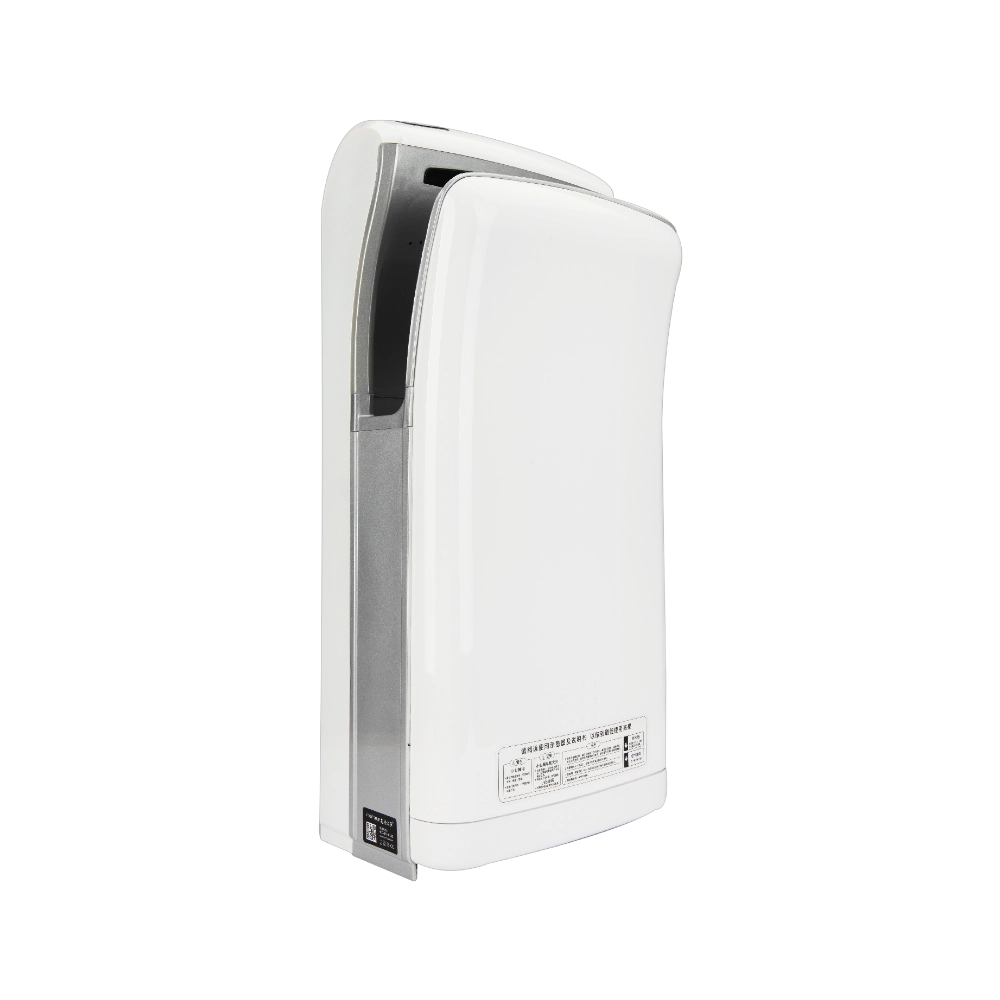
Secador de mãos Interhasa 1688

Interhasa 1688 classic model double side air outlet high speed 1800W hand dryer, with light indicator, 4 infrared sensor, on/off switch, hot/cold switch, multy color available to match your deco design, accept for OEM order or brand distributor.

Explorar produto
Secador de mãos Interhasa 1688

How To Calculate Estimated Annual Electricity Costs? 

The following equation can be used by facility managers to calculate the annual cost of electricity. Multiply total kW by operating hours, daily user cycles, and your local power rate.

Annual Cost = (Watts ÷ 1000) × (Dry Time in Seconds ÷ 3600) × Daily Uses × 365 × Electricity Rate

Calculation Example

Assume that there is a restroom that uses 200 cycles per day at an electricity cost of $0.15 per kWh.

550W Unheated Unit (10-second dry time):

Annual Cost = (550 ÷ 1000) × (10 ÷ 3600) × 200 × 365 × 0.15

Annual Cost = (0.55) × (0.00278) × 200 × 365 × 0.15

Annual Cost ≈ $16.74

1800W Heated Unit (30-second dry time):

Annual Cost = (1800 ÷ 1000) × (30 ÷ 3600) × 200 × 365 × 0.15

Annual Cost = (1.80) × (0.00833) × 200 × 365 × 0.15

Annual Cost ≈ $164.18

Send your destination voltage, daily traffic estimate, quantity and electricity rate for a model-level operating-cost comparison.

 Como calcular um período de retorno defensável para um secador de mãos

O retorno simples deve utilizar o custo líquido instalado, não apenas o preço do produto. Inclua o secador, a cablagem, os trabalhos de parede e a colocação em serviço, e depois subtraia qualquer custo evitado de dispensador. As poupanças mensais devem incluir as compras de papel, a mão de obra de reabastecimento e o tratamento de resíduos menos a eletricidade, a manutenção e os filtros de substituição. Publique cada pressuposto para que o comprador o possa substituir por dados locais.

Entrada ou saída Símbolo Como obtê-lo Fórmula ou utilização Não assumir
Potência nominal de entradaP Página oficial do produto do modelo selecionado, placa de características ou registo de teste aprovado Utilizada no cálculo da energia por utilização Uma potência média da categoria
Tempo de secagem medidot Teste controlado utilizando o modelo aprovado e o ponto final de mãos secas acordado Utilizada no cálculo da energia por utilização Tempo de marketing de outro modelo
Utilizações por diaU Contagem no local, estudo de tráfego ou estimativa conservadora da instalação Utilizações anuais = U × dias de funcionamento Cada visitante utiliza o secador uma vez
Tarifa de eletricidadeR Fatura da instalação ou tarifa contratada Aplicada aos kWh anuais Uma média nacional quando a tarifa do local é conhecida
Custo instalado do projetoI Unidade, frete, direitos, instalação e trabalho elétrico necessário Investimento inicial para o retorno Apenas o preço do produto
Custo evitado de toalhasT Faturas reais de toalhas divididas por secagens bem-sucedidas Custo anual evitado de consumíveis Custo por caixa sem folhas/utilização e desperdício
Custo de mão de obra e resíduosL Tempo de reabastecimento, tempo de limpeza, tratamento de resíduos e registos de eliminação Adicionar apenas o custo evitável documentado Toda a mão de obra desaparece após a instalação
Custo de manutençãoM Serviço planeado, filtros, peças e tempo de inatividade previsto Deduzir do benefício anual A manutenção é zero
Energia por utilizaçãoE Calculada a partir de P e t verificados E (kWh) = P (W) × t (s) ÷ 3.600.000 A potência nominal por si só é igual ao custo por utilização
Custo anual de eletricidade do secadorCe Calculado a partir de E, U, dias de funcionamento e R Ce = E × U × dias de funcionamento × R 365 dias de funcionamento para todas as instalações
Benefício líquido anualB Calculado a partir de custos evitados e novos custos operacionais B = T + L – Ce – M Todas as economias alegadas são economias em dinheiro
Período de retorno simplesRetorno Calculado após as entradas serem aprovadas Retorno = I ÷ B; use unidades de tempo correspondentes Uma alegação de retorno sem divulgar pressupostos

What is the Total Cost Comparison between Hand Dryer and Paper Towels? 

Analyzing hand dryer vs paper towel cost savings highlights massive reduction in ongoing operational expenses. 

Hand dryers reduce the cost of operation in the bathroom to 95%. Although installing them is more expensive than buying paper towels because of the initial capital needed for the purchase and installation, they eliminate ongoing expenses for consumables, storage, restocking labor, and waste disposal.

Estimated Cost Comparison Table

Cost Component Secador de mãos Toalhas de papel
Upfront Cost High ($400 – $2,000 per unit + electrical installation) Low ($30 – $150 per dispenser)
Cost Per Use Negligible ($0.0002 – $0.0018 in electricity) High ($0.01 – $0.03 for 2–3 towels per dry)
Annual Operating Spend Very low ($15 – $100 per year in power) High ($700 – $1,200+ per year for supply)
Hidden Costs Minimal periodic maintenance High labor (restocking, trash, plumbing clogs)
Payback Period 6 to 14 months average ROI Ongoing permanent expense

What are the Key Electrical Infrastructure Considerations?

The installation of the restroom components involves assessing the load of the circuit and distribution of the panel. The heavy load of the power increases the cost of installation in building retrofits.

Circuit Load / Retrofit Costs

An average 1800W dryer consumes 15 Amps at 120V power line. This requires an individual circuit of 20A for each dryer. 

At 550W, the consumption is less than 4.6 Amps at 120V. Three units of 550W can be installed in one 15A circuit branch. This low current draw eliminates panel upgrades, saves copper wiring, and cuts electrical installation costs.

How to Choose a Low-Wattage Model?

To choose low-wattage models, consider the design of the motor, choice of materials used to build the housing, and customizing capabilities by the manufacturer before buying. Personalized B2B negotiations with the manufacturer provide room for customized solutions based on facility voltages.

The factory-direct approach provides for personalized tuning of the motor and better pricing because of volume ordering. Ordering the motors with custom wattage will ensure proper balance between airflow, noise, and power consumption.

Interhasa offers commercial hand dryer models with different power ratings, drying times, materials, and voltage configurations for offices, hospitality, public facilities, and high-traffic commercial environments. Visit our Hand Dryer Catalog ou contact us to request customized low-power solutions and prices.

FJ6/ST Spring-type DIN Rail Terminal Block

Safer Experience: Built-in heating element with multiple protections for long life.
HEPA Filter: High-quality built-in HEPA filter for hygienic, pure air flow.
Adjustable Cold and Hot Wind Mode: Cold and hot air exchange for different seasons.
Durable material: Premium ABS, waterproof, strong, wear-resistant, for various places.
3-Year Warranty: 3-year manufactory limited warranty with free parts and good service.

Explorar produto
FJ6/ST Spring-type DIN Rail Terminal Block

 Como os Compradores Devem Verificar Alegações de Eficiência Energética

Antes de aceitar uma alegação de “até 80%”, solicite a potência de entrada testada, o tempo de secagem, a potência em standby, as condições de teste e a linha de base de comparação. Um modelo com menor wattagem não é automaticamente mais eficiente se demorar muito mais tempo a secar as mãos. As compras devem comparar a energia por secagem completa e a vida útil esperada do motor.

Buyer Checklist 

Energy-Efficient Hand Dryer Buying Checklist

  • Rated power (W)
  • Drying time per cycle
  • Energy consumption per cycle
  • Standby power
  • Voltage and frequency
  • Circuit requirements
  • Motor efficiency
  • Nível de ruído
  • Filter/maintenance requirements
  • Garantia
  • Expected service life
  • OEM/ODM availability
Cartão de CTA

Pedido de Documentos Elétricos

Solicite documentos de potência, tempo de secagem e elétricos para os modelos pré-selecionados.

Ver mais →

Principais conclusões

  1. Hand dryer energy consumption depends on both power rating and drying time, not wattage alone.
  2. Energy per use can be calculated by multiplying power consumption by operating time and converting the result to kWh.
  3. A 550W hand dryer operating for 10 seconds uses approximately 0.00153 kWh per drying cycle.
  4. Hand dryer ROI depends on equipment cost, installation, electricity, paper towel savings, maintenance, and daily usage.

Retorno simples (meses) = Custo líquido instalado ÷ Poupança mensal em custos operacionais. Mostre o custo líquido instalado, eletricidade, papel, mão de obra de recarga, tratamento de resíduos e manutenção como entradas separadas para que os compradores possam substituir pressupostos por cotações locais.

Perguntas Frequentes (FAQs) 

1. What is the most energy-efficient type of dryer?

  • The most energy-efficient dryers are those that employ the heat pump technology, for restroom hand dryers, energy efficiency depends mainly on measured input power, drying time, standby power and the number of cycles.

2. What is an energy-efficient dryer?

  • Energy-efficient dryers consume the lowest amount of electricity as compared to other types, up to 60% less than vented or condenser dryers. They utilize a closed system where the same warm air is cycled and reused.

3. How much electricity does a hand dryer use?

  • Os secadores de mãos normalmente usam até 500W a 2000W de eletricidade por sessão de secagem. A energia por ciclo deve ser calculada por modelo. Por exemplo, 550W × 10 segundos ÷ 3.600.000 = 0,00153 kWh por sessão de secagem, o consumo de energia é insignificante—1.800W × 30 segundos ÷ 3.600.000 = 0,015 kWh.

BLOGS RECENTES
UV Soap Dispensers: Does UV Light Really Kill Germs?

Quick Answer  While does UV kill germs is proven by science, a UV soap dispenser can only act as a primary defense on any liquid soaps and dispensing nozzles, but not as an instant liquid sterilization. For facility managers, choosing a UV-C soap dispenser provides an extra layer of hygiene, provided the device adheres to […]

Setembro 30, 2026
Top 10 Soap Dispenser Manufacturers & Wholesale Suppliers in China

Quick Answer  Finding the right soap dispenser manufacturer requires evaluating factory capacity, compliance standards, and order minimums. For businesses seeking a soap dispenser wholesale supplier in China, Interhasa provides automatic and manual commercial soap dispensers with full international certifications.  This guide helps bathroom importers, brand owners, and wholesalers select top Chinese suppliers for global distribution. […]

Setembro 30, 2026
CE vs SASO vs GOST: Qual é a Certificação de Louças Sanitárias Certa para Exportação para Você?

Resposta Rápida Escolher a estratégia de certificação de exportação de louças sanitárias certa depende do seu país-alvo ou clientes específicos. A Europa exige conformidade CE, a Arábia Saudita impõe padrões SASO, enquanto a Rússia segue as regulamentações GOST. No entanto, as louças sanitárias Interhasa cumprem integralmente as normas internacionais de segurança e qualidade. Este artigo explica os caminhos de certificação técnica para evitar alfândega […]

09 de setembro de 2026
OBTENHA UM CONTATO PARA
ENVIE-NOS UMA MENSAGEM
Obter uma cotação
Procurar
FAÇA PARCERIA COM OS ESPECIALISTAS EM SECADORES DE MÃOS.

Como fabricante certificado, oferecemos preços competitivos para compras em grande quantidade e soluções personalizadas para a sua marca.