
Visite-nos na 139ª Feira de Cantão! Fase 1: Estande 3.1L38 | Fase 2: Estande 10.1i33-34

×

Is Your Hand Dryer Too Loud? A Guide to Noise & Decibel Levels

Julho 22, 2026

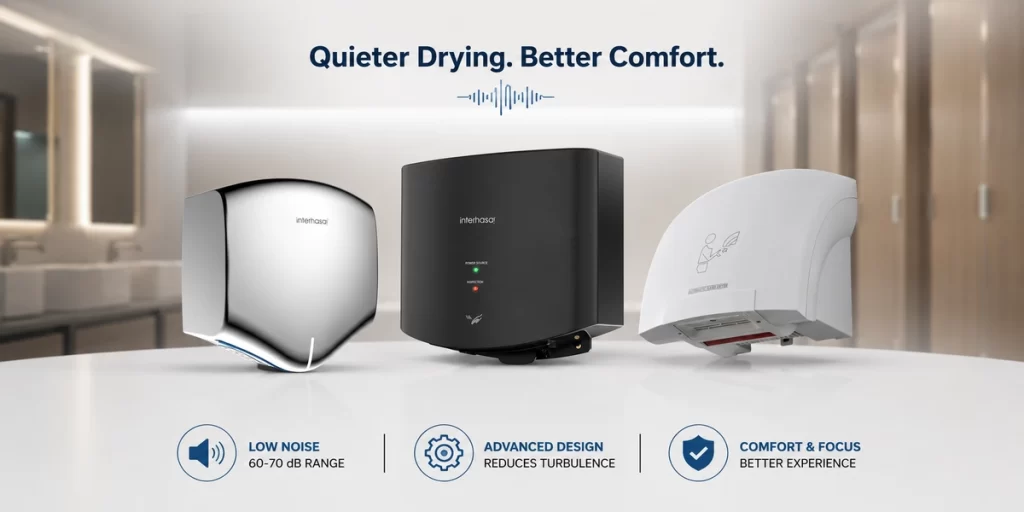
Interhasa low noise series commercial hand dryers restroom product showcase

A low noise hand dryer is a non-negotiable specification when outfitting high-traffic restrooms adjacent to noise-sensitive zones like office pods or library wings. In my field experience, installing a high-decibel unit in a hollow-walled restroom often leads to immediate tenant complaints that require expensive remedial soundproofing. Selecting the right acoustic profile during the design phase ensures that high-speed performance does not disrupt the building’s operational workflow.

Most commercial hand dryers operate between 60 and 90 dB.

In general:

  • 60–70 dB is considered quiet and suitable for offices, hotels, schools, and healthcare facilities.
  • 70–80 dB balances drying speed and noise for most public restrooms.
  • Above 80 dB is typically reserved for high-traffic environments where fast drying is prioritized over acoustic comfort.

Besides the published decibel rating, motor type, airflow design, installation surface, and room acoustics all influence how loud a hand dryer actually sounds in daily use.

Why Noise Level Matters

In commercial facilities, the commercial hand dryer noise level directly impacts user retention and employee focus throughout the workday. A hidden failure point insight I often share with clients is the risk of sound bleed through ventilation shafts into adjacent conference rooms, which can derail high-stakes professional meetings. Choosing a unit with a 60–70 dB range shows a commitment to detail and long-term facility management efficiency, especially when the restroom layout consists of 100% hard, reflective tile surfaces.

How Hand Dryer Noise Is Measured

The comparison below shows the typical noise levels across different commercial hand dryer categories, making it easier to identify low-noise options.

Hand dryer noise level guide comparing different commercial dryer decibel ranges

Buyers shouldn’t rely on showroom impressions; they need standardized acoustic data. Most professional manufacturers, such as Interhasa, a leader established in 2007 with a 14,000m² facility, measure sound pressure from two meters in controlled labs to ensure consistency. When specifying equipment, check certifications against ISO 3744 to verify that sound power claims are accurate and compliant with international standards.

Decibel (dB) basics for facility buyers

The hand dryer db rating is measured on a logarithmic scale, and a 10 dB increase is generally perceived as about twice as loud to the human ear. Because of this, many facility buyers prefer units below 70 dB where occupant comfort is a priority. A unit that seems quiet in a large open space will sound much more aggressive in a small, enclosed restroom with echo-prone corners, which is why technicians must factor in the room’s total cubic volume during the initial site audit.

Decibel scale chart comparing low noise Interhasa hand dryer sound level

Typical Decibel Range by Hand Dryer Type

Matching the dryer type to the room’s specific acoustics is the difference between a successful installation and a long-term maintenance headache.

High-Speed Jet Dryers (75-90dB)

Engineered for high-throughput environments like stadiums, these units use high-pressure air blades to strip water in under 10 seconds. The resulting air turbulence makes them louder than traditional models, which is often an unacceptable trade-off in executive suites or private clinics.

Warm Air Dryers (60-75dB)

These rely on evaporation and slower air velocities, making them inherently quieter for sensitive restrooms. Modern advancements have allowed manufacturers to bridge the gap, offering updated versions like the Interhasa Economic Hand Dryer Model 905 which balances motor speed and airflow to reduce perceived operating noise.

What Makes a Hand Dryer Loud

Achieving silence requires sophisticated internal geometry and high-quality components to manage air resonance and mechanical vibration during operation.

Motor Design

Mechanical noise originates primarily in the motor brushes. Brushless models significantly reduce friction and vibration compared to older alternatives. High-quality units such as the Hand Dryer 3861 are a favorite for field engineers because they maintain a 60-70 dB profile even while operating at 25,000 r/min. By selecting a low noise hand dryer with brushless technology, you also extend the unit’s operational lifespan and reduce long-term maintenance cycles.

Airflow Velocity

Turbulence at the outlet creates the characteristic “whooshing” noise often found in low-cost equipment. The Interhasa model 3891 addresses this with a curved intake and outlet design. This geometry allows air to flow smoothly through the 304 stainless steel casing, minimizing the mechanical resistance and air-shearing noise found in flat-vented models.

Interhasa Hand Dryer 3861

Interhasa model 3861 hand dryer, the classic high speed hand dryer, booster small rectangle air outlet, dry your hand in 6-10 seconds, low noisy to 60-70 DB, air filter to clean the air, on/off switch button, hot/cold switch button on body surface, easy to operate.

Explorar produto
Interhasa Hand Dryer 3861

Why Two Hand Dryers with the Same dB Rating Can Sound Different

A published decibel rating does not always reflect the real user experience.

Two dryers with the same measured noise level can sound noticeably different because of:

  • Airflow frequency and pitch
  • Air outlet design
  • Brushless vs brushed motors
  • Wall material (concrete vs hollow partition)
  • Room size and sound reflection

For example, a 70 dB dryer installed on a hollow drywall partition may be perceived as significantly louder than the same model mounted on a concrete wall because vibration amplifies the sound.

How to Choose a Quiet Commercial Hand Dryer

When selecting commercial hand dryers, match the technical specifications to the installation site’s acoustic needs. Prioritize units with adjustable “Eco” modes or hot/cold switches that allow maintenance teams to tune the output based on occupancy levels or seasonal requirements. Integrating a low noise hand dryer into your workflow ensures the restroom does not bleed sound into professional work areas or patient recovery zones, preserving the building’s functional integrity.

Best-Fit Environments (Schools/Hotels/Offices)

The benefits of quiet operation are clearest in specialized facilities where noise pollution disrupts core activities. Finding quiet hand dryers for schools is vital for students with sensory sensitivities who may be startled by loud high-speed motors. In luxury settings like boutique hotels or wellness spas, low noise floors are essential to preserve the high-end atmosphere and ensure overall guest satisfaction.

Troubleshooting & Common Installation Mistakes

Sudden noise increases usually indicate a clogged air filter or a loose internal bracket causing casing vibration. During the commissioning workflow, ensure the unit is decoupled from the wall using rubber isolation gaskets to prevent the partition from acting as a resonator. Professionals avoid installing high-speed dryers in small, tile-heavy restrooms without adding acoustic baffles, as reflected sound can make the dryer seem significantly louder than its published dB rating.

Which Noise Level Fits Your Facility?

FacilityRecommended Noise Level
Escritório60–70 dB
Hotel60–70 dB
School65–75 dB
Hospital≤65 dB
Aeroporto75–85 dB
Stadium80–90 dB

Instead of choosing the quietest model available, match the dryer’s noise level to daily traffic, user expectations, and surrounding environments. For most commercial buildings, a 65–75 dB model provides the best balance between drying speed and acoustic comfort.

Product Workflow Recommendation

Match the model to the specific operational requirements of your facility zone.

ModelNoise LevelKey Acoustic FeatureDry Time
Secador de mãos 386160 – 70 dBRectangular air outlet6 – 10s
Interhasa Model 3891Optimized Low-Noise DesignCurved intake and outlet10 – 12s
Hand Dryer 905Lower noise degreeBalanced motor speed and airflow10 – 15s

Conclusão

Selecting a low noise hand dryer is about respecting the user experience and the building’s acoustic integrity. By prioritizing brushless motors, curved airflow paths, and verified dB ratings, you can avoid costly retrofits and noise-related complaints. For long-term reliability and professional-grade performance, I recommend outfitting your facility with the latest Interhasa hand dryers.

Clean Interhasa production workshop assembly line with 3S management signage

Perguntas frequentes

What is considered a “quiet” decibel level for a hand dryer?

Any unit operating under 70 dB is generally considered quiet for a commercial environment. For sensitive areas like libraries or spas, looking for models closer to the 60 dB mark is recommended.

Why has my quiet hand dryer suddenly become much louder?

This usually signals a clogged air filter or a loose internal component causing casing vibration. Verify that the air filter is clear and all internal mounting brackets are secure to restore the original sound profile.

How do I minimize noise during the installation process?

Use rubber isolation gaskets to decouple the unit from the wall and avoid mounting on hollow stud partitions adjacent to quiet rooms. This prevents the wall from acting as an amplifier for motor vibrations.

Obter uma cotação
Procurar
FAÇA PARCERIA COM OS ESPECIALISTAS EM SECADORES DE MÃOS.

Como fabricante certificado, oferecemos preços competitivos para compras em grande quantidade e soluções personalizadas para a sua marca.