


Interhasa Modell 3897 SS-Stahl-Händetrockner
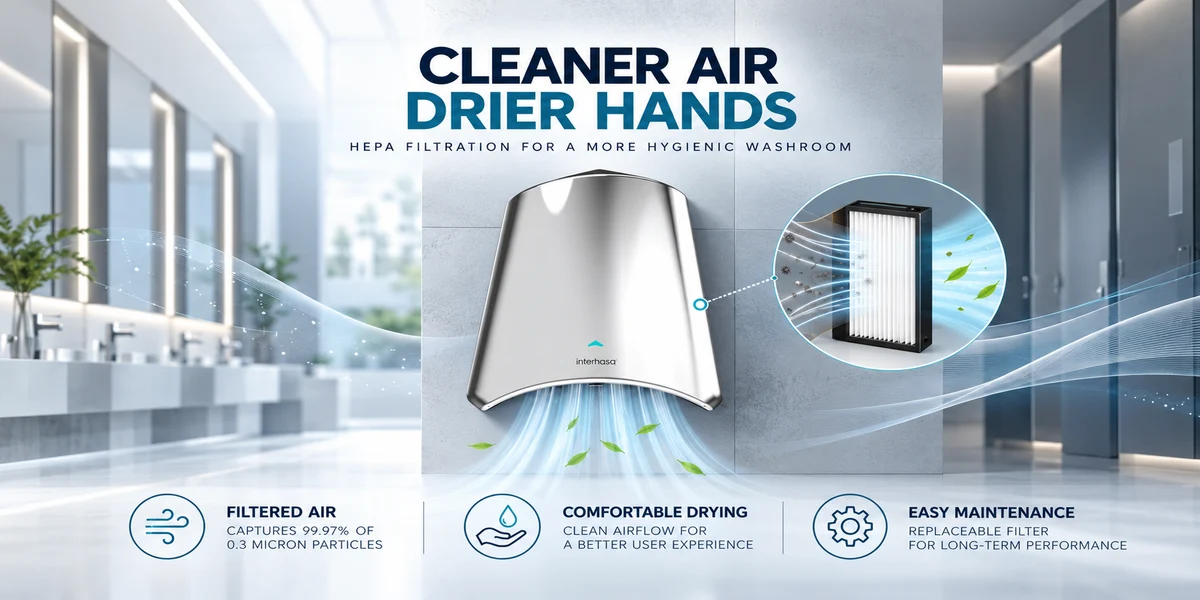
Patented Design high speed hand dryer ss steel shell material, concentrated air outlet with hepa air filter, anti-stolen backboard.
Produkt ansehenMeet Us at 140th Canton Fair! Phase 1 Booth:3.1M31 I Phase 2 Booth:10.1 I33-34

A hand dryer with HEPA filter will be able to trap airborne particles, providing a filtration advantage in commercial restrooms. Filtration does not necessarily mean infection control, and filter resistance may impact airflow and drying ability. Prior to making a purchase, check for filter effectiveness, air seal, drying ability, noise level, energy usage, and filter replacement cost.
When choosing a hand dryer for commercial washroom applications, one must consider filtration efficiency together with airflow resistance, drying time, noise, electrical consumption, and filter replacement cost. One must evaluate the Interhasa Modell 3897 SS-Stahl-Händetrockner for projects requiring stainless-steel housing and a HEPA filter. Prior to installation, one should make sure that the filter efficiency documentation is provided, as well as its drying performance with the filter, electrical requirements, and replacement filters availability.
The HEPA filter operates using mechanical filter media to trap particles as air flows through the filter. According to the U.S. Environmental Protection Agency, a HEPA filter is a filter able to capture at least 99.97% of particles that are 0.3 microns in diameter under the filtration definition. This figure refers to filter efficiency rather than the dryer efficiency.
HEPA filter hand dryer takes the air in the surrounding environment into its intake port, filters the air via the filter assembly, and blows the filtered air into the hands. Consumers need to make sure they get the testing procedure, efficiency ratings, and identification information about the filter, and make sure there is no unfiltered air leakage.
These dryers may be appropriate for airports, hotels, food-service facilities, healthcare support areas, and busy commercial washrooms where filtration is an additional equipment requirement. Their suitability depends on the facility’s hygiene policy, ventilation, user volume, cleaning procedures, and available performance evidence; filtration should complement, not replace, established hygiene controls.
For contractors, installation planning should include electrical provisions, wall construction, mounting clearances, and access for filter servicing. When evaluating a Kommerzieller Händetrockner with HEPA filter, consider how the equipment fits the actual washroom layout and maintenance workflow rather than selecting it on the filter label alone.
A correctly specified filter can capture airborne particles passing through its media, while a properly designed dryer can provide convenient hand drying in high-use washrooms. However, filtration alone does not prove that a unit prevents infections, eliminates all microorganisms, or delivers completely germ-free air at the outlet.
A hygienic hand dryer should be evaluated through documented filtration performance, cleanable surfaces, suitable placement, and a realistic maintenance plan. Question absolute health claims unless relevant independent evidence supports the precise claim under defined test conditions.
Request the filter specification, particle-size efficiency, test report, and documentation identifying the component supplied with the dryer. Inspect the filter housing, gaskets, access cover, and airflow path for bypass points; a replacement filter that fits physically but fails to seal correctly can compromise the intended filtration performance.
Before approving a model, request documentation for its exact filter configuration and verify the reported filtration efficiency and housing-sealing performance. A product description is a starting point for evaluation, not independent proof of whole-unit filtration efficiency; confirm the supporting test evidence before specifying equipment for projects with defined filtration requirements.
Confirm the replacement filter’s part number, availability, price, recommended service interval, and replacement procedure before purchasing. A hand dryer air filter that is difficult to access or expensive to replace can create recurring maintenance costs, particularly in facilities with heavy daily use.

Assign inspection and replacement responsibilities in the maintenance schedule, and retain records of service dates and parts used. If airflow falls, inspect for filter loading, blocked intakes, loose seals, and motor problems before replacing components; identifying the cause first helps prevent repeat work and avoidable downtime.
Filtration can increase airflow resistance depending on filter area, media design, dust loading, and fan capacity. A Hochgeschwindigkeits-Händetrockner with HEPA filter must therefore be evaluated with its specified filter installed, because motor speed and advertised drying time alone do not establish actual performance under operating conditions.
Compare documented drying time, sound level, power consumption, and airflow under stated test conditions. Request comparable test data for the production configuration, since a prototype tested without its specified filter may perform differently after installation.
| Buyer check | Evidence to request | Why it matters |
|---|---|---|
| Filtration | Filter specification and test report | Establishes the documented filter rating |
| Airflow | Performance data with the filter installed | Identifies possible resistance or reduced output |
| Noise and power | Test figures and rated consumption | Supports operating-cost and user-comfort decisions |
| Wartung | Replacement part number and service instructions | Helps control downtime and recurring expenses |
| Installation | Mounting dimensions and electrical requirements | Reduces installation changes and commissioning delays |

Before releasing a purchase order, verify the filter documentation, assembly sealing, mounting dimensions, electrical requirements, service access, and replacement-part availability. Confirm that performance data applies to the exact model and filter configuration quoted, rather than another product in the same range.
Use a consistent approval workflow:
This process helps contractors identify specification gaps before installation, when correcting a problem is generally easier than modifying equipment after handover.
Patented Design high speed hand dryer ss steel shell material, concentrated air outlet with hepa air filter, anti-stolen backboard.
Produkt ansehen
A reliable selection process helps buyers confirm that the dryer meets project requirements, remains practical to maintain, and performs as specified. Verifying these factors before purchase reduces approval risks and helps avoid costly changes after installation.
For a project shortlist, compare the technical requirements with Interhasa Händetrockner and request supporting documentation for the exact model under consideration. A hand dryer with HEPA filter should be approved only when its evidence, installation requirements, and maintenance plan support dependable long-term operation.
A HEPA hand dryer is a hand dryer designed to pass incoming air through a high-efficiency particulate filter. Buyers should verify the filter specification, housing seals, and complete-unit performance rather than assuming every product advertised with a filter meets the same standard.
A loaded filter, blocked intake, damaged seal, or motor fault can reduce airflow. Inspect the complete air path and compare measured performance with manufacturer documentation before replacing parts.
Check the technical documents, mounting and electrical requirements, filter access, and replacement parts. After installation, verify filter seating, sensor operation, airflow, and drying performance before commissioning approval.