


Interhasa Commercial Bathroom Baby Changing Station Model X1005
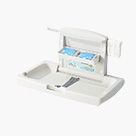
HDPE unit with safety belt; open 820*540*390mm, closed 820*540*105mm. Useful for checking drawings and mounting clearances.
View ProductMeet Us at 140th Canton Fair! Phase 1 Booth:3.1M31 I Phase 2 Booth:10.1 I33-34

A commercial baby changing station sourcing process should begin with defined site requirements, a factory audit, and a sample assessed against written acceptance criteria. Verify safety evidence, dimensions, fixings, material consistency, and traceability before authorizing production.
Factory Audit Must Determine If Approved Sample Is Typical of Regular Manufacturing Control and Not Just A Showpiece. Interhasa’s Models X1005 and 1002 descriptions contain HDPE construction materials, safety belts and dimensional information for the preliminary review. It is important for the buyer to check batch control, recordkeeping on material input, inspection process and change control documentation to ensure that mass produced unit meets the approval criteria of an approved sample.
Before contacting a baby changing station supplier, define the installation location, expected traffic, wall construction, cleaning products, accessibility needs, and destination-market requirements. These details reduce the risk of approving a sample that later proves unsuitable for the actual site.

Responsibility for checking the compliance requirements must be assigned and the list of necessary documents for procurement must be prepared. For US commercial project, scope of ASTM F2285-22 for commercial diaper changing tables must be reviewed and specific model and configuration evidence must be requested.
For a commercial baby changing station, trace incoming materials through production using material identification, supplier records, molding checks, storage controls, and inspection logs. On HDPE components, look for warping, sink marks, sharp flash, uneven surfaces, and color variation; visual inspection alone cannot verify material composition or performance.
Compare workmanship, labels, and components across production stages. A capable baby changing station manufacturer should explain how nonconforming parts are isolated, corrective actions documented, and finished products traced to their production lots. Ask how the factory prevents unapproved material or component substitutions after sample approval.
Request the test method, sample identification, test date, results, and acceptance criteria behind each load or durability claim. Operate the platform through repeated opening and closing cycles, check hinge movement and fasteners, inspect restraint anchor points, and confirm that warnings and product labels are legible.

A demonstration does not prove compliance. If records are missing, the sample differs from the tested configuration, or a restraint slips from its anchor, document the failure and require corrective action before approval. Verify that the evidence applies to the supplied model rather than a visually similar product.
Compare the sample with the Interhasa Model X1005 listing where relevant, then verify current drawings, open and closed dimensions, mounting points, clearances, and supplied hardware. Confirm the wall substrate, backing, fastener type, mounting height, and installation sequence to avoid rework on site.
HDPE unit with safety belt; open 820*540*390mm, closed 820*540*105mm. Useful for checking drawings and mounting clearances.
View Product
Instructions should identify the correct model and explain installation, operation, inspection, and maintenance. Resolve discrepancies between drawings, hardware, and the sample before shipment, and record the approved document revision in the purchase file. If site conditions require a different fixing arrangement, obtain technical approval rather than improvising during installation.
Inspect edges, seams, hinges, restraint surfaces, and recesses where moisture or residue may collect. Check compatibility with the facility’s cleaning products and look for cracks, burrs, exposed fasteners, pinch points, or gaps that could trap dirt or catch skin.
Use adequate lighting and operate moving parts while assessing cleaning access. Record each defect with a photograph, location, severity, and required correction so a general assurance cannot replace a specific corrective action. Confirm that staff can inspect and clean the unit without dismantling components unnecessarily.
Use a checklist with pass, fail, and not-applicable fields; record measurements, photographs, label details, and the sample identification number. A commercial baby changing station sample must match the agreed specification and drawings, with failed checks repeated after corrective action.
Compare the physical sample with the Interhasa Model 1002 listing when evaluating that model. Keep a signed golden sample or controlled reference record, and require production to match its approved materials, components, finish, dimensions, and function. Changes to material, mold, hinge, restraint, or assembly method must be disclosed and approved before production continues.
HDPE unit with safety belt; open 510*340*328mm, closed 510*340*145mm. Compare these figures against your approved sample.
View Product
The request for quotation (RFQ) should specify the model, quantity, destination market, drawings, materials, dimensions, test evidence, packaging, labels, inspection access, and delivery terms. For baby changing station wholesale orders, define sampling procedures, defect classifications, document deadlines, change control, corrective-action timing, and responsibility for reinspection or replacement.
Agree on acceptance criteria before production starts, including how defects are reported, who approves corrective actions, and when shipment may be released. This aligns procurement, quality, and installation teams while reducing disputes over undocumented changes or inconsistent products.
A commercial baby changing station should not be approved on appearance or price alone; sourcing requires traceable evidence, a site-suitable design, and repeatable inspection criteria. A disciplined audit reduces late rework, unclear responsibilities, and production inconsistencies.
Before ordering, review the baby changing station option against the project specification and confirm the approved sample, supporting documents, and change-control terms in writing. This gives contractors a clearer basis for installation, inspection, and commissioning.
It checks whether material controls, assembly procedures, traceability, test records, labels, and installation documents support the agreed specification. It also establishes how the factory records defects and verifies corrective actions.
Document the failure with photographs or measurements, request corrective action, and repeat the relevant test before approval. Do not release production based only on a verbal assurance.
Confirm the current drawing, wall substrate, backing, fasteners, mounting height, operating clearance, and model-specific instructions. Record the approved revision and require written approval for subsequent changes.