
¡Visítanos en la 139.ª Feria de Cantón! Stand Fase 1: 3.1L38 | Stand Fase 2: 10.1i33-34

×

Grifos con sensor de ahorro de agua: Guía de cumplimiento con las normas LEED, CalGreen y WaterSense

18 de agosto de 2026

Respuesta rápida

Commercial facilities can achieve full compliance with LEED v4.1, CalGreen Title 24, and EPA WaterSense standards by installing efficient water saving sensor faucets. Interhasa automatic sensor faucet systems reduce commercial restroom water usage by up to 70%. 

By combining infrared sensor activation with low flow rates, these fixtures lower utility bills and help projects earn valuable green building credits. This guide explains how commercial plumbing fixtures comply with water saving standards while delivering optimal operational performance.

Water-saving sensor faucet with touchless operation, reduced water consumption, and sustainable performance for commercial washrooms.

How Much Water Sensor Faucets Actually Save?

The typical GPM output of a commercial manual faucet is 2.2 gallons per minute GPM. People often keep manual valves on when scrubbing and drying soapy hands. The automatic touchless faucet stops water flow immediately after hands have moved out of the sensor range.

Studies suggest that an automatic faucet uses 1 gallon of water less per handwashing cycle than a traditional manual handle faucet. A busy commercial airport or school restroom facility can save more than 30,000 gallons each year per fixture. Notably, touchless electronic faucets avoid flooding resulting from manually open valves in baños públicos.

In addition, low water usage translates into energy savings on water heating for commercial facilities. Lower water usage results in lower natural gas or electricity charges for commercial facilities. Commercial property owners reduce maintenance costs due to lack of mechanical handle use on the touchless electronic controls.

What are LEED Points & CalGreen Requirements?  

The Leadership in Energy and Environmental Design (LEED) rating system awards points for indoor water reduction. Building projects earn WE Credit: Indoor Water Use Reduction by specifying a low-flow leed sensor faucet. Baseline calculations require a 20% reduction below standard federal flow baselines for baseline point thresholds.

A 30%-50% water savings results in up to 6 LEED points for commercial developments. Inclusion of a 0.5 GPM touchless faucet facilitates easy meeting of mandatory LEED efficiencies by commercial projects. Mandatory compliance is based on certified documentation on the flow rates, technical specifications sheets, and third-party plumbing certification.

CalGreen Title 24 provides strict green building regulations for new commercial buildings. Section 5.303.3 in CalGreen stipulates a mandatory lavatory flow rate of 0.5 GPM for public commercial toilets. Use of a compliant watersaving sensor faucet ensures that mandatory building standards of California state are met for all commercial districts.

Grifo automático para baño comercial Interhasa modelo 202

Engineered with a high-efficiency 0.5 GPM flow restrictor to meet mandatory CalGreen and LEED indoor water reduction standards. Features solid brass construction and fast infrared activation for heavy-traffic restrooms.

Explorar el producto
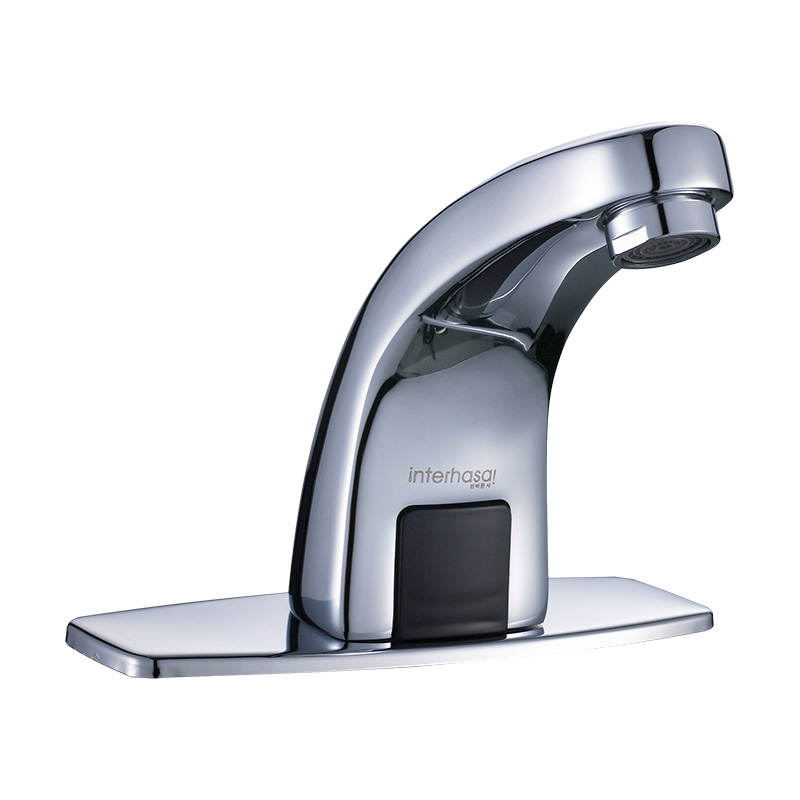
Grifo automático para baño comercial Interhasa modelo 202

How Does WaterSense Certification Work for Faucets?

The US Environmental Protection Agency (EPA) handles the certification of plumbing products via its WaterSense program. Any WaterSense certified faucets should be able to operate with 20% greater efficiency compared to regular federal baseline fixtures. Commercial lavatory touchless faucets should have a maximum flow rate of 1.5 GPM.

In order to be WaterSense certified, water spray coverage, cycle efficiency, and structural valve durability when subjected to constant hydraulic pressure is confirmed by independent laboratory tests. Performance tests regarding sensor response time, battery performance, and valve durability are conducted through daily operation. 

Certified fixtures display the official EPA WaterSense label on product packaging and technical specification literature. International buyers from Europe and elsewhere look out for third-party certifications in order to comply with regulatory requirements during the procurement process.

Which GPM Specs to Look For? 

Selecting the correct sensor faucet GPM specification depends on your specific facility type and foot traffic. Aerators with a maximum flow rate of 0.5 GPM or 0.35 GPM need to be installed in public restrooms in office buildings, airports, and stadiums. Aerators of 1.0 GPM or 1.5 GPM are commonly used in executive bathrooms or hotel guest rooms. 

  • Public Restrooms (High-Traffic): 0.35 – 0.5 GPM is Recommended (Complies with LEED v4.1 & CalGreen Title 24).
  • Office Bathrooms (Medium Traffic): 0.5 GPM is Recommended (Complies with EPA WaterSense & LEED).
  • Hotel & Guestrooms: 1.0 – 1.5 GPM is Recommended (Complies with EPA WaterSense).

Modern electronic aerators add air to the water flow to sustain water pressure with a low flow rate. Brass body, solenoid valve life span, and infrared detection range are important technical parameters of the selection of aerators. 

Selection of proper sensor power systems, such as AC/DC transformer, DC battery, or power module, avoids system malfunctions. Dual Power sensors automatically switch to the battery mode in case of grid power failure.

Preguntas frecuentes (FAQ) 

How do WaterSense faucets work?

  • WaterSense faucets reduce the flow of water to a maximum of 1.5 gallons per minute (GPM), thus reducing the consumption of water by at least 30% compared to the standard 2.2 GPM faucets by employing specific water-saving devices such as aerators or flow control devices.

What does WaterSense certified mean?

  • To be certified WaterSense is to indicate that a product or home, or profession, has been found to meet the criteria set by the U.S. Environmental Protection Agency (EPA) when it comes to water efficiency and effectiveness. All products that have been certified use at least 20 percent less water than their counterparts.

What are some water-saving fixtures?

  • Water-saving fixtures refer to plumbing fixtures that have been developed to minimize indoor water usage through 20% to 60% with no compromise on efficiency. Examples of water-efficient fixtures include dual-flush toilet systems, aerator faucets, and low-flow shower heads.

BLOGS RECIENTES
CE vs SASO vs GOST: ¿Cuál es la certificación de exportación de accesorios de baño adecuada para usted?

Respuesta rápida Elegir la estrategia de certificación de exportación de accesorios de baño adecuada depende de su país o clientes objetivo específicos. Europa sí requiere el cumplimiento de CE, Arabia Saudita aplica las normas SASO, mientras que Rusia se adhiere a las regulaciones GOST. No obstante, los accesorios de baño Interhasa cumplen plenamente con las normas internacionales de seguridad y calidad. Este artículo explica las rutas de certificación técnica para prevenir aduanas […]

septiembre 09, 2026
Accesorios de baño personalizados de marca privada y OEM: Una guía para propietarios de marcas que se expanden al sector comercial

Respuesta rápida Para los propietarios de marcas residenciales que se expanden a espacios comerciales, Interhasa suministra accesorios de baño personalizados como grifos con sensor y dispensadores de jabón automáticos. Seleccionar un socio OEM de accesorios de baño comerciales en China le permite lanzar rápidamente líneas de productos escalables y de alta durabilidad. Un proveedor OEM eficaz también puede ayudar a facilitar la personalización de productos, la producción en masa y una calidad constante en proyectos a gran escala […]

septiembre 08, 2026
¿Qué tan caliente se pone un secador de pelo? Guía de seguridad y hoteles

El humilde secador de pelo es un elemento básico en casi todos los hogares. Seca el pelo rápidamente, facilita el peinado y ahorra tiempo. Pero ¿te has preguntado alguna vez cuánto calor alcanza un secador de pelo o si ese calor podría dañar tu cabello? Lo cierto es que un secador puede alcanzar temperaturas sorprendentemente altas, a veces tan altas que […]

05 de septiembre de 2026
CONSIGUE UN CONTACTO PARA
ENVÍANOS UN MENSAJE
Obtenga una cotización
Buscar
ASÓCATE CON LOS EXPERTOS EN SECADORES DE MANOS.

Como fabricante certificado, ofrecemos precios competitivos al por mayor y soluciones personalizadas para su marca.