
Meet Us at 140th Canton Fair! Phase 1 Booth:3.1M31 I Phase 2 Booth:10.1 I33-34

×

Sensor Faucet Retrofit: 7 Checks Before Replacing Manual Taps

Ноябрь 07, 2026

Quick Answer:

This guide gives you seven checks to complete before you order. You will learn what to measure at the basin, how to judge the mounting opening, why basin shape and spout reach matter, where the sensor should sit, how to plan power and service access, and what to test before sign-off. You will also get a practical request for quotation (RFQ) checklist. The goal is not to prove a sensor faucet can be fitted, but that the exact model fits your basin and can be maintained.

1. What Should You Measure at the Basin and Water Supply?

Start with the basin as a system, not as a hole in a countertop. Record the basin length, width, internal depth, deck width, backsplash position and the distance from the mounting point to the front and rear edges. Photograph the basin from above and below with a ruler in view. Add a simple sketch showing the existing tap, supply pipes, stop valves and any obstruction under the deck.

Then audit the water supply. Confirm whether hot and cold supplies are both present, their pipe diameter and connection type, and whether the existing stop valves turn freely. Measure pressure with a gauge at the supply point, preferably both when water is static and when it is flowing. Flowing pressure matters because it drops when other fixtures open.

The sensor faucet range includes several mounting designs, so do not use photographs alone to choose one. Start with your measured site data, then ask the supplier to confirm the exact model against those dimensions.

2. Will the Existing Deck and Mounting Hole Accept the New Faucet?

A worker in safety glasses and gloves measures around a chrome sensor faucet mounted on a white sink in a tiled restroom, with the text "Measure the site" and "Illustrative scene" on screen.

Deck thickness is the distance from the top surface of the counter to the underside where the faucet body, washer and fixing nut must fit. A thick stone top, a secondary substrate or a reinforcing plate can all reduce the usable thread length. Measure the full sandwich rather than only the visible surface.

The mounting hole needs two dimensions: diameter and position relative to the basin. A hole that is too small may require drilling, which is not always practical in stone or tiled decks. A hole that is too large may leave an exposed gap or allow the faucet to move. An adapter plate or a different faucet base may solve the problem, but only if the manufacturer documents that arrangement. Do not rely on sealant to bridge an oversized opening.

Check the space below the deck as well. The control box, flexible connectors and valve must fit without pressing against a cabinet, drawer, trap or wall. The Interhasa Model 202 page describes a control box and pipe accessories, but its text does not give deck thickness, hole diameter or under-deck dimensions. Request the dimensional drawing and confirm those measurements before release.

3. How Do Basin Shape and Clearance Affect Hand Position?

Chrome sensor faucet with water flowing over cupped hands in a white sink, with a soap dispenser and plant nearby and a label reading Check hand position.

Spout reach is the horizontal distance from the faucet mounting point to where water leaves the spout. If the reach is too short, users wash against the rear of the basin. If it is too long, water may hit the front edge or splash beyond the basin. Basin clearance is the usable space between the spout outlet and the basin floor; it needs to accommodate a hand comfortably without forcing contact with the bowl.

Basin shape changes the answer. A shallow rectangular basin, a deep vessel bowl and a sloping undermount basin do not offer the same usable target area. Check where the water stream lands when a user stands naturally, not only where the spout points in a catalog image. Look for interference from the backsplash, mirror, soap dispenser, hand dryer or partition.

The C201 product page lists the same pressure, sensor range and power ratings as Model 202, but those figures do not define spout reach or basin fit. Treat them as model data to verify, not as proof that either faucet suits your basin. If accessibility is part of the brief, include reach and clearance in the design review and confirm local requirements.

4. Where Should the Sensor Sit to Avoid Splash?

A commercial sensor faucet typically uses an infrared sensor: it emits light and detects the reflection from a hand, then signals the valve to start water flow. The sensor’s effective position depends on the spout geometry, basin depth, user posture and surrounding surfaces. A sensor close to the water stream or a reflective fitting may behave differently from a bench test.

Model 202 and C201 pages state a 30 cm induction range. That is a page-stated figure, not a guarantee that every user will activate the faucet from 30 cm away in your washroom. Test the proposed mounting position with the intended basin and a representative group of users. Watch for activation before hands enter the washing zone, shutdown while hands are still moving, and water hitting the rim or floor.

The guide to infrared faucet operation explains the basic sensor-and-valve sequence. Use it to brief the installer, then verify the result on site. Splash control is a layout issue as much as a faucet issue: a deeper basin, a suitable aerator angle and a clear hand position may matter more than a different sensor specification.

5. Which Power and Service-Access Plan Fits the Site?

The Model 202 and C201 pages list AC 110–220 V or DC 6 V power. The choice affects installation work and routine maintenance. A DC arrangement may avoid running new wiring through finished walls, but batteries still need to be reachable, replaced and stocked. An AC arrangement avoids routine battery changes, but the electrical route, adapter or connection point and local electrical requirements must be confirmed.

The AC versus DC power guide sets out the trade-off in more detail. Neither option is automatically more reliable. Confirm which power components are included with the faucet, where the control box will sit, and how the unit behaves during a power interruption.

Valve access is the next test. The solenoid valve is the electrically operated valve that opens and closes the water supply. If it is buried behind a sealed panel or above a fixed ceiling, a routine service call can become a demolition job. Provide access to the control box, valve, power connection, battery compartment where fitted, and the local stop valves. Agree who will service those components and which spare parts must be kept on site. A sensor faucet is only convenient if the maintenance team can reach it.

6. How Do You Test Flow, Mixing and Shutoff?

The product pages state a water pressure range of 0.05–0.6 MPa, roughly 0.5–6 bar. Ask whether that range refers to static or flowing pressure, then compare it with your measured site conditions. A static test can pass, yet flowing pressure may fall outside the range when other fixtures run.

Test the complete wash cycle. Confirm that the faucet activates promptly, delivers a usable stream, maintains a stable temperature and shuts off when hands move away. Check for drip at the spout and leaks at the supply connections after the valve closes. If hot and cold supplies are connected through a mixing arrangement, test the temperature at the mixed outlet and confirm how the adjustor is set and locked.

Record the flow rate at the installed pressure, because the Model 202 and C201 pages do not state one. Ask the supplier for the rated flow and any test conditions. Also ask what happens on power loss or low battery, and test the documented behaviour rather than assuming the valve fails closed. A written commissioning sheet should show activation, shutoff, leak, temperature and pressure results, with a pass or fail mark for each basin.

7. What Should the Retrofit RFQ Include?

An RFQ is a request for quotation: the package you send to a supplier so it can price and confirm the right configuration. Make it a fit-check document, not a one-line request for a price. Include dimensioned basin photos, deck thickness, mounting-hole diameter, required spout reach, static and flowing pressure, supply arrangement and the proposed power route. State what the maintenance team needs to reach without removing panels.

Ask for the exact model, dimensional drawing, cutout details, kit contents, installation manual, flow data and any market-specific documents required for the project. Request a sample or first-article approval if the basin geometry is unusual, and define how the sample will be checked against the drawing. Include order quantity, destination, packaging requirements and the commercial terms you need quoted.

Use the Interhasa FAQ page for general company information, but put project-specific questions in the RFQ so the answer is tied to your model and order. A supplier should be willing to mark the drawing as approved, state exclusions and identify any site work that remains the contractor’s responsibility.

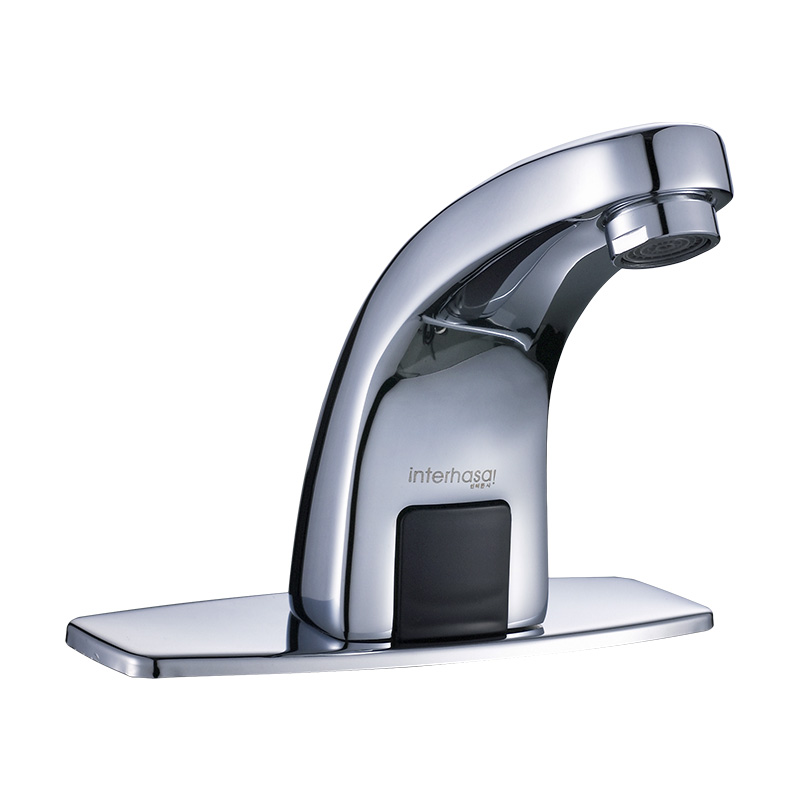
Interhasa Коммерческий Автоматический Смеситель Для Ванной Комнаты Модель 202

Interhasa sensor faucet model 202, for commercial bathroom usage, pure copper material,durable chrome surface. DC or AC power dual supply,with control box and 1-3 pipe accessary , a 3 connector hot/cold adjustor. Welcome to contact us for more model.

Исследуйте продукт
Interhasa Коммерческий Автоматический Смеситель Для Ванной Комнаты Модель 202

Часто задаваемые вопросы

Can Any Manual Tap Be Converted to a Sensor Faucet?

No. The existing mounting hole, deck thickness, basin shape and supply arrangement may rule out a direct replacement. Some projects need a different faucet base, an adapter plate, new countertop work or a revised power route. Check the exact model against measured site data before accepting a claim of universal compatibility.

Is Battery Power Always Easier for a Retrofit?

It can reduce the need to run new wiring, but it is not automatically easier to own. Confirm battery type, expected service interval, replacement access and spare-part availability. High-traffic washrooms may justify mains power and accessible electrical connections instead. Compare installation disruption with the routine maintenance workload.

What If the New Faucet Does Not Fit the Existing Hole?

Ask whether the manufacturer offers a documented adapter or cover plate for that model. Otherwise, choose a faucet with a suitable base or revise the deck. Do not enlarge a hole, bridge a gap with sealant or omit a fixing without approval from the contractor and product supplier. The fit decision should be made before the countertop is modified.

Итог

A sensor faucet retrofit is a fit-check project, not a catalog swap. Confirm the basin and supply, deck thickness, mounting hole, basin clearance, sensor position, power route, valve access, flow, mixing and shutoff before you approve the order. If one of those checks fails, change the model or change the installation plan; do not assume the faucet will adapt.

Interhasa self-produces faucets, so you can send the basin sketch, dimensions, pressure readings, power preference and target market directly for a model review. Standard orders have no general MOQ; custom packaging has its own MOQ. Orders above USD 8,000 qualify for free FOB Ningbo, and lead time is quoted against the confirmed order. Use the страницу контактов to start an RFQ and ask for the drawing package before committing to the retrofit.

Получить предложение
Поиск
СОТРУДНИЧАЙТЕ С ЭКСПЕРТАМИ ПО СУШИЛКАМ ДЛЯ РУК.

Как сертифицированный производитель, мы предлагаем конкурентоспособные оптовые цены и индивидуальные решения для вашего бренда.