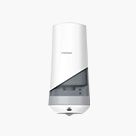



Secador de manos de alta velocidad Interhasa con bandeja de agua, modelo A3889
Secador de manos de alta velocidad Interhasa con bandeja de agua, modelo A3889
Explorar el productoMeet Us at 140th Canton Fair! Phase 1 Booth:3.1M31 I Phase 2 Booth:10.1 I33-34

Every drying-time figure is a page-stated claim until you see the test method and repeat it on a sample. Results depend on hand wetness, hand size, nozzle distance, sensor response, room conditions and what counts as “dry.” Ask for the protocol and raw data, then test a sample beside competing models. Interhasa manufactures hand dryers in-house and can supply model data for that review.
A “high-speed” label describes airflow design, not a guaranteed cycle time. Two suppliers can quote “8 seconds” from tests with different wetness, endpoints and users. This guide shows how to compare the claims, run a fair sample test and write an RFQ that produces checkable evidence.
Drying time is an outcome, not a specification. It depends on starting water, hand size, position in the air stream, user movement and the definition of “dry.” A test that stops when hands look dry can finish much sooner than one that weighs residual moisture.
The protocol matters as much as the hardware: wetting method, water temperature, the walk from basin to dryer, rubs, room humidity, supply voltage and sensor response. A claim from small hands and a visual endpoint is not comparable with one across a range of hand sizes to a moisture threshold.
Air speed is not drying time. The A3889 product page lists 95 m/s and no drying-time figure. The A3881 page states “8-10 seconds.” Both are page-stated; neither publishes a test method, so neither is a guaranteed cycle time. A high outlet velocity can coexist with a narrow stream, a slow sensor or a hand position outside the air pattern. User technique matters too: cupping the hands, rubbing them together or holding them at the edge of the stream all change how much skin the air reaches.
A useful protocol states its conditions before it reports a time. The ETL method for high-speed hand air dryers, used for the UK Energy Technology List, is one published example, though not the only valid method.
In that method, the room is held at 23 ± 5°C and 55 ± 5% humidity, with water at 37 ± 2°C. Volunteers immerse their hands to the wrist crease. Six volunteers complete five tests at each of three intervals; results use residual moisture below 0.15 g, discard the highest and lowest volunteers, and report a standard drying time of 15.5 seconds or less.
Ask whether the supplier’s number came from a similar protocol or a quick demonstration. Ask for the document, not a summary. If the method is proprietary, ask which conditions it controls and which it leaves to the operator.
Hands dipped and shaken off carry less water than hands lifted straight from a basin; hands that drip carry more. The difference can be several seconds, especially at the end of the cycle when only a thin film remains.
A fair test defines the wetting procedure, water temperature, soak time, transfer time and whether the user shakes. If one sample is tested after a three-second walk and another after ten, the second starts drier and looks faster.
“Dry” can mean no visible water, no feeling of dampness, or residual moisture below a stated threshold. The first can be reached while the skin still holds water; the last is repeatable but needs a scale and a written procedure.
Ask which endpoint the supplier used. If the answer is “until dry,” ask who judged it and how many people took part. The endpoint should match how guests use the dryer and how your cleaners judge the floor.

Test the samples as a group, using the same volunteers, water temperature, mounting height, distance from the basin and room conditions. Randomize the order so the last sample does not benefit from a practiced user or a drier room.
A practical test needs a scale accurate to 0.01 g, a stopwatch, paper towels, a written script and at least six people with a mix of hand sizes. Run several trials per person. Weigh the towel before and after the final wipe, and record the time to your chosen endpoint. Note the model, settings and sensor range for each unit, since a changed setting can move the result.
Report the median and the slowest result for each group. Compare the distribution, not the best run: one fast result and several slow ones do not make a fast dryer for planning. Use the slow figure for queue and energy estimates, and keep the raw notes. If a supplier refuses a side-by-side test, treat that as a data gap.
A shorter cycle is only part of the package. Higher air speed and motor speed can change the sound profile, the feel on the skin and the amount of water pushed sideways. The question is whether the unit meets your noise limit at the mounting position, not whether the brochure says “quiet.”
A strong air stream can also move water across the floor if the hand position is poor or the unit sits close to a wall. Watch a sample with wet hands before you approve the position, and check the floor beyond the drying zone.
A decibel number without distance, room and measurement conditions is not comparable. The A3881 page states a run sound of 70-80 dB, a page-stated range for that model rather than a category promise. Listen at the nearest desk, table or guest area, and judge the tone as well as the level. Ask which standard was used, and require the same one from every supplier.
Power needs the same discipline. The A3889 page states 1250 W; the A3881 page states 1100 W, split as a 550 W motor and a 550 W heater. These are page-stated ratings, not a ranking. A higher-wattage unit can dry faster and still cost more to run, or run longer and use more energy per cycle. Calculate energy per cycle from rated power and measured run time, then confirm circuit capacity with the nameplate and a qualified electrician. The electrical requirements guide explains why wattage alone does not size a circuit.

A water tray catches drips before they reach the floor, but it is a maintenance item. Ask how it is removed, how often it must be emptied and whether the finish suits your normal washroom chemicals.
The A3889 page describes a water-tray design and lists IPX1 protection. IPX1 covers vertically falling drops under defined conditions; it does not mean the unit can be hosed down. The IPX1 vs IPX4 guide explains the difference. Match the rating and tray design to your cleaning method. Trays also collect soap and lint, so a shape that is hard to remove and rinse will cost more cleaning time than a smooth one.
In a busy washroom, a small tray may need emptying more often than the cleaning schedule allows. Confirm who does that task before you choose the model.
Ask for evidence you can compare on the same basis:
Request the same document set for each competing model so the comparison is like-for-like.
Secador de manos de alta velocidad Interhasa con bandeja de agua, modelo A3889
Explorar el producto
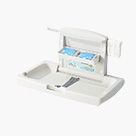
Interhasa manufactures hand dryers in its own production operation and also supplies soap dispensers, paper towel dispensers, faucets, wall-mounted hair dryers and baby changing stations. CE and RoHS documentation applies to the hand dryer range; ask for the exact model. Standard orders have no general MOQ, custom packaging has its own minimum, orders above USD 8,000 qualify for free FOB Ningbo, and lead time is set by the confirmed order.
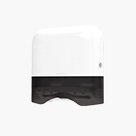
For a quiet area, the paper dispenser range is a useful non-electric comparison: a manual dispenser avoids the dryer’s electrical load but adds consumables, storage and waste. The commercial hand dryer specification guide covers the dryer side of that trade-off.
No. “High speed” describes airflow or motor design, not measured drying time. A unit with a wider air pattern, a better sensor or a shape that keeps hands in the stream can beat a nominally faster model on real hands.
Only when the protocols match. Check wetting, hand size, endpoint, number of users, transfer time, room conditions and whether the figure is an average, best result or maximum. If any differ, the numbers are not comparable.
Not automatically. Air speed at the nozzle is one variable; air pattern, temperature, distance, sensor response and user movement also matter. A high m/s figure can coexist with a narrow stream or a slow start.
No, but you need method. A consistent script, six or more volunteers, a 0.01 g scale and a written endpoint will expose large differences. A lab is useful for a formal tender number; a disciplined in-house test is enough to challenge a brochure claim.
Verify a claim in four steps: ask for the protocol, check the endpoint and hand wetness, test a sample with your own users, and compare noise, power and water management as a package. A page-stated number is a starting point, not a specification.
Interhasa’s hand dryer range includes the A3889 water-tray model and other configurations. Send your voltage, mounting location, expected traffic, sample quantity and market, and ask for the drawing, test method and certificate documents for the exact SKU. Contact the team to arrange a sample review and quotation; include your order value and packaging needs so MOQ, FOB Ningbo terms and lead time can be confirmed.